CANO: Context-Aware Noise Optimization for Adversarial Privacy Protection
Adaptive noise injection that concentrates protection where it matters most
Abstract
We present CANO (Context-Aware Noise Optimization), an adaptive noise injection system that optimizes the privacy-utility tradeoff in adversarial privacy protection. Unlike uniform noise strategies that apply identical perturbations across all features, CANO allocates noise proportionally to each feature's contribution to re-identification, concentrating protection where it matters most while preserving utility on low-impact features.
We additionally train a Deep Q-Network (DQN) policy through adversarial co-evolutionary training,
where the defense adapts against an attacker that continuously retrains on protected data.
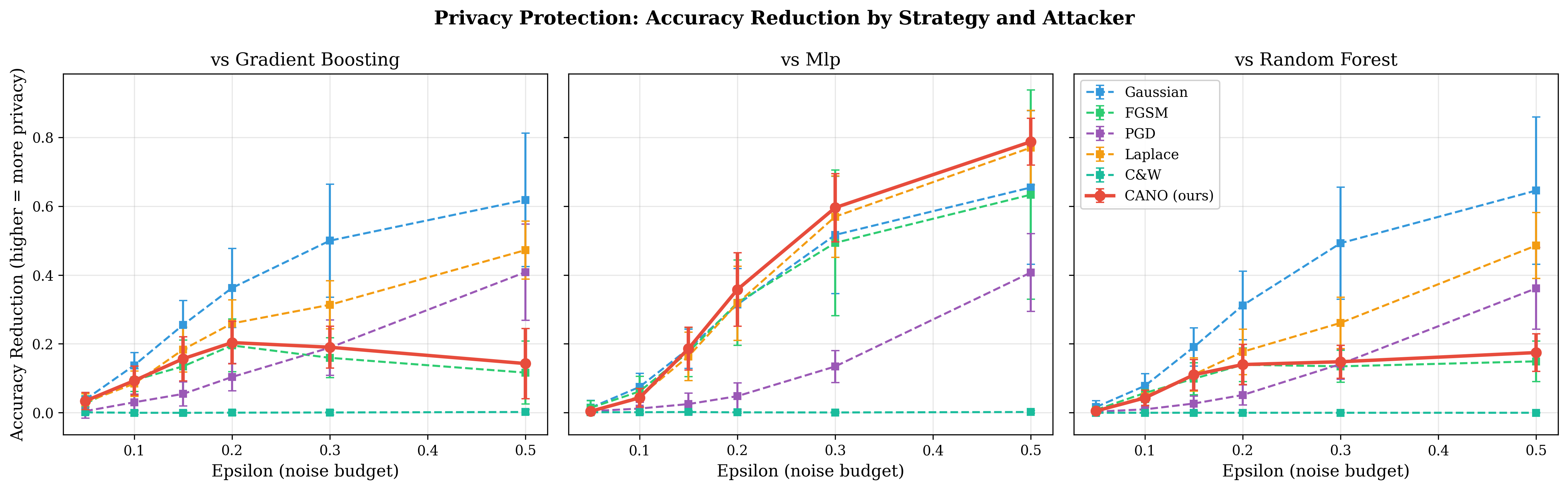
We evaluate CANO against five baseline strategies (Gaussian, FGSM, PGD, Carlini-Wagner, and Laplace noise)
across 12 datasets (including the real FP-Stalker browser-fingerprint corpus — 776 users, 13,674 fingerprints),
3 attack models, and 6 noise budgets, totaling 68,885 experimental configurations
(54,281 in-scope after excluding the 2-user cybersec_intrusion dataset).
Key Results
Strategy Comparison
| Strategy | Accuracy Reduction | Utility Preserved | Adaptive Robust |
|---|---|---|---|
| Gaussian | Uniform across features | Moderate | Low |
| FGSM | Gradient-based, single step | High | Low |
| PGD | Iterative gradient | High | Moderate |
| Carlini-Wagner | Optimization-based | Highest | Moderate |
| Laplace | DP-style uniform | Low | Low |
| CANO (Ours) | Context-aware adaptive | High | High |
Method
CANO resolves the fundamental tension in privacy-preserving noise injection: too little noise allows re-identification, too much breaks legitimate services, and uniform noise wastes budget on low-impact features while under-protecting critical ones.
-
Feature Importance Analysis —
Train a classifier on fingerprint samples and measure each feature's contribution
to re-identification via permutation importance. High-impact features like
canvas_hashandwebgl_hashare identified. - Proportional Noise Allocation — Concentrate noise budget on features that contribute most to tracking. Low-impact hardware attributes receive minimal perturbation.
- Reinforcement Learning — A DQN agent learns to allocate noise budgets dynamically based on observed attacker behavior and feature sensitivity.
- Adversarial Co-Evolution — Attacker and defender train against each other over 30 rounds. The defense adapts as the attacker retrains on protected data, producing robust long-term privacy guarantees.
where ε is the noise budget, wi is the feature importance weight, and zi is drawn from N(0,1) or from the gradient direction when a target model is available.
Evaluation
We evaluate across a comprehensive experimental grid:
- 12 datasets — 3 controlled synthetic, 6 overlap/size-stress variants, 1 public keystroke (CMU 51-users), 1 real browser-fingerprint corpus (FP-Stalker, 776 users), and 1 out-of-scope binary dataset
- 3 attack models: Random Forest, Gradient Boosting, MLP — each retrained on protected data (adaptive setting)
- 6 noise budgets (ε): 0.05, 0.10, 0.15, 0.20, 0.30, 0.50
- 6 defense strategies: Gaussian, FGSM, PGD, C&W, Laplace, and CANO
On the real FP-Stalker corpus, CANO closes most of the gap to Gaussian (mean accuracy reduction 0.276 vs 0.340) — substantially tighter than the small-synthetic gap, suggesting importance-weighted allocation generalizes better under realistic feature distributions.
In adversarial co-evolutionary training, CANO reduces attacker re-identification accuracy from 74.8% to 20.8% within 30 rounds, demonstrating sustained robustness against adaptive adversaries that retrain on protected data.
Contact
For questions about this research, please reach out via the project repository or email the research team.